Flight guide · Updated November 2026
What plane am I flying?
Type, tail number and swaps
The aircraft decides more about your flight than the fare does: how many seats are in a row, whether the seat you picked even exists, sometimes whether there is a business cabin at all. The type is usually visible the moment you book. The exact aircraft, the one with a specific registration on its tail, shows up much later. Here is where to look for each, why it changes, and what to do when it does.
In brief
- The aircraft type (A320neo, 737-800, 777-300ER) is planned months ahead and shown in the flight details on the airline's site and most booking sites.
- The seat map tells you more than the type name: the number of rows and the seat layout reveal which cabin version you are getting.
- The exact aircraft is identified by its registration. Flight trackers show it once the airline has tied a plane to your flight, usually close to departure.
- It can change right up to boarding: a technical fault, a knock-on delay, a bigger or smaller plane for demand, another airline flying the route for yours.
- Under EU261, if a swap pushes you into a lower class, the airline owes you 30%, 50% or 75% of the ticket price within seven days.
Step 1: find the aircraft type
- Open the flight details. On the airline's site, in its app and on most booking sites, expanding a flight shows the aircraft type and the operating airline. It is right there before you pay, which is the best moment to check.
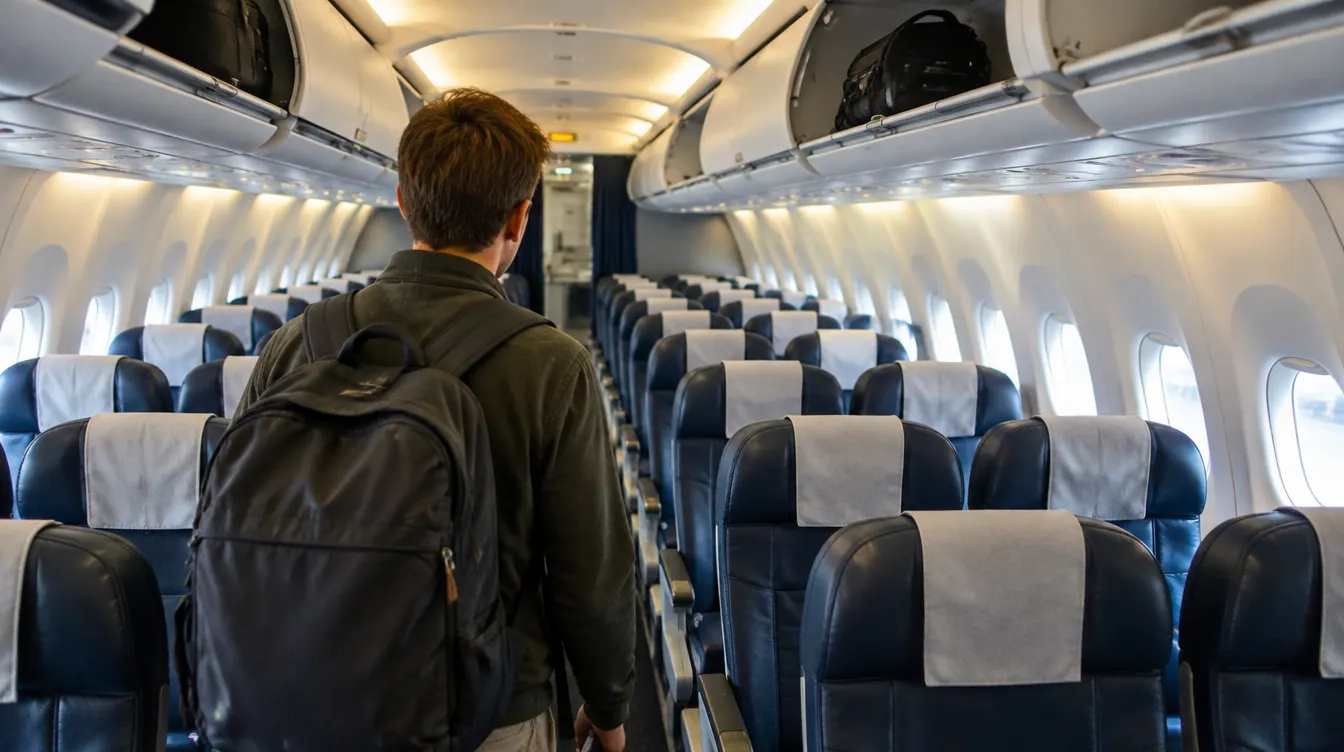
- Look at the seat map. Seat selection during booking or at online check-in shows the real layout: three-and-three or two-four-two, how many rows, where the exits are. Two aircraft of the same type can have very different cabins, so the map beats the name.
- Check a flight tracker. Search your flight number on Flightradar24 or FlightAware. For future flights it shows the planned type; on the day it usually adds the registration.
Trackers often show the type as a four-character code instead of a name. These come from ICAO's list of aircraft type designators, which air traffic control uses. The common ones are easy to decode:
| Code | Aircraft | Typical layout in economy |
|---|---|---|
| A20N | Airbus A320neo | Narrow-body, 3+3 |
| B738 | Boeing 737-800 | Narrow-body, 3+3 |
| B38M | Boeing 737 MAX 8 | Narrow-body, 3+3 |
| A359 | Airbus A350-900 | Wide-body, two aisles |
| B77W | Boeing 777-300ER | Wide-body, two aisles |
Step 2: find the exact aircraft
The registration is the aircraft's licence plate, painted on the fuselage. A flight number moves between planes every day; the registration stays with one airframe. Once a tracker shows it for your flight, you can search the registration itself and see that aircraft's recent and scheduled flights.
That is useful for two things. The flight just before yours on that list is your inbound plane, the best early clue to a delay (more in where is my plane now). And the registration's flight history tells you which version of the cabin you are about to sit in, when an airline runs several.
Don't read much into a registration a week before departure. Airlines plan the type early, but they assign the actual aircraft late and keep reshuffling it. I check it on the day.
Why the plane changes
- A technical fault. If the planned aircraft is grounded, the airline puts a spare or another aircraft from its schedule on your flight, sometimes a different type.
- Knock-on delays. When one plane is running late, airlines reshuffle aircraft to protect the rest of the day's schedule. Your registration can change several times in an afternoon.
- Demand. A bigger plane for a full flight, a smaller one for an empty one. Schedule changes like this often happen weeks ahead and show up as a new seat map.
- Another airline. Sometimes a different carrier, with its own aircraft and crew, flies the route for the airline you booked. EU rules require you to be told the operating airline at booking and, if it changes, as soon as possible and at the latest at check-in.
- Same type, different cabin. Airlines refit their fleets gradually. In February 2026 Lufthansa wrote that its Boeing 787-9 flies to Toronto, Montréal, Lagos and Malabo partly with and partly without its new Allegris cabin.
What to do when the aircraft changes
- Recheck your seat. After a swap the airline's system reassigns seats to fit the new map. A window can become a middle; a paid extra-legroom seat may not exist on the new plane. Pick again in the app or at check-in, and ask for a refund of a seat fee you can no longer use.
- Know the downgrade rule. On flights covered by EU261, if you are placed in a lower class than you paid for, the airline must reimburse 30% of the ticket price on flights up to 1,500 km, 50% on intra-EU flights over 1,500 km and other flights of 1,500–3,500 km, and 75% on everything else, within seven days.
- An upgrade is free. The same article says that if the airline puts you in a higher class, it cannot ask you to pay extra.
- Note the operator. If another airline operates the flight, it is the operating carrier that answers for delays and cancellations under EU261. Keep the email that tells you about the change.
For picking the seat itself once you know the plane, see how to choose the best seat on a plane.
Where Bordy fits in
I fly a lot and I like knowing what's waiting at the gate, so this is personal. Add a flight to Bordy by number and it follows it from FlightAware's data, re-checked every two minutes while the flight is active, with free push alerts for gate changes, delays (with the old and new time), boarding, departure and landing.
Bordy Pro answers the question in the title directly: it puts the aircraft's registration, serial number, operator and a photo on the flight card, so you can see whether it's the plane you expected and which airline actually flies it. Pro also shows where the aircraft for your flight is right now. Every aircraft type you've flown ends up in your statistics. Bordy doesn't manage seats: after a swap, the seat is still something to check in the airline's app. Pro costs €44.99 a year with a three-day free trial, or €1.99 a week.
Questions people actually ask
How do I find out what plane I'm flying on?
How do I find the tail number of my flight?
Can the airline change the aircraft after I've booked?
What do codes like A20N or B77W mean?
Where these numbers come from
- Regulation (EC) No 261/2004, Article 10 (EUR-Lex) — checked 21 November 2026
- Regulation (EC) No 2111/2005, Article 11: identity of the operating air carrier (EUR-Lex) — checked 21 November 2026
- Your Europe: air passenger rights — checked 21 November 2026
- ICAO: Doc 8643, Aircraft Type Designators — checked 21 November 2026
- FAA Order JO 7360.1J, Aircraft Type Designators (PDF) — checked 21 November 2026
- Flightradar24 support: how can I find flights? — checked 21 November 2026
- Lufthansa Group newsroom: Allegris business class seats on the Boeing 787-9, 24 February 2026 (German) — checked 21 November 2026