Flying calm · Updated November 2026
Fear of flying:
numbers, noises, breathing
Fear of flying rarely listens to statistics, but it does listen to explanations. Most of what sets it off is a sound, a sensation or a wait you don't understand. Below: what ICAO and IATA actually counted last year, what each noise on board is, a breathing drill you can practise at home, and what a proper fear-of-flying course looks like.
In brief
- The numbers are small even in a bad year. ICAO counted 4 fatal accidents among about 38 million scheduled flights in 2025.
- Most noises are the plane doing its routine: landing gear, flaps, a planned thrust reduction after take-off, speed brakes, reversers after touchdown.
- Turbulence is a seat-belt problem, not a wing problem. Keep the belt on whenever you're seated.
- Slow breathing helps, if you practise it before the flight. The NHS drill takes five minutes.
- Courses work best when they end with a real flight and a psychologist on board. Lufthansa runs one-day and weekend versions.
What the safety numbers actually say
Two bodies count air accidents worldwide: ICAO, the UN's aviation agency, and IATA, the airline association. They define an accident slightly differently, so their totals never match. They agree on the picture, though.
| ICAO (published July 2026) | IATA (published March 2026) | |
|---|---|---|
| Flights in 2025 | About 38 million | 38.7 million |
| Accidents | 85 (95 in 2024) | 51 (54 in 2024) |
| Fatal accidents | 4 (10 in 2024) | 8 (7 in 2024) |
| People killed | 387 | 394 on board |
| Rate | 0.11 fatal accidents per million departures | One accident per 759,646 flights |
Two things stand out. Most accidents in these reports kill nobody: 81 of ICAO's 85 were non-fatal. And one crash can swing a whole year: ICAO notes that a single accident in 2025 accounted for 260 of the 387 deaths, which is why deaths went up while accidents went down.
If you prefer one figure: ICAO puts 2025 at 78 deaths per billion passengers carried. By my arithmetic, that is roughly one death per 12.8 million passengers. ICAO's own summary of the long-term trend is "continuous improvement".
What the noises mean
The scariest sounds are usually the most routine. Here's what you're hearing at each stage, from the FAA's flying handbook and its rules for noise-abatement departures.
| When | What you hear | What's happening |
|---|---|---|
| Seconds after take-off | A thump and rumble under the floor | The landing gear retracts once the plane is climbing. The gear doors open and close again |
| During the climb | The engines suddenly get quieter | A planned thrust reduction to cut noise over houses. US guidance says no lower than 800 ft (about 240 m) |
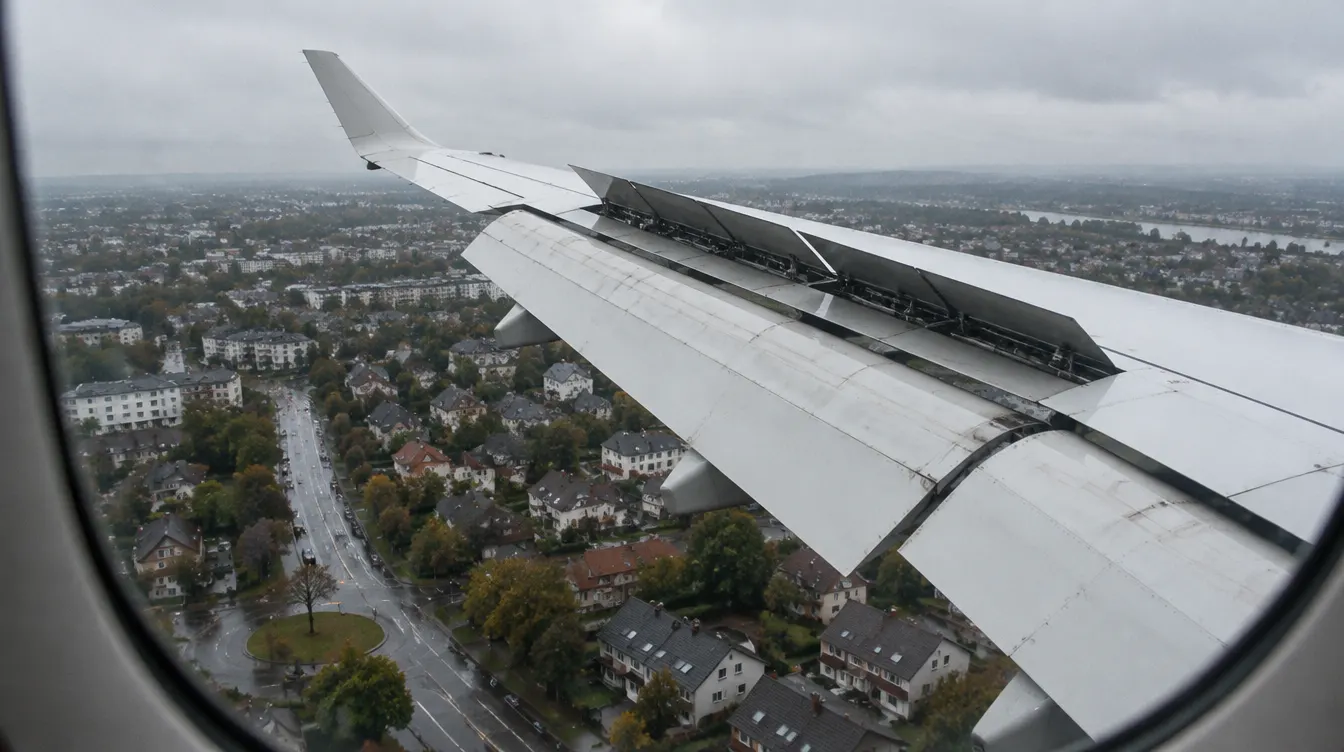
| Early in the climb | Whirring from the wing | The flaps come in once the plane has gained height and speed. The FAA handbook says not below 400 ft |
| Descent | Rumble and light shaking | Speed brakes. The FAA handbook says there is usually some noise and buffeting when they're out |
| Approach | Whirring, then a thump | Flaps going out and the gear coming down |
| Right after touchdown | A loud roar from the engines | Thrust reversers and spoilers helping the brakes slow the plane |
The big fear behind many of these sounds is an engine giving up. US certification rules (14 CFR 25.121) require a twin-engine airliner to keep climbing after take-off with one engine failed, with the gear up. A twin is designed from the start to cope with losing one.
Turbulence, briefly
EASA, the EU's aviation safety agency, puts it simply: most of the time turbulence is harmless, because planes are built to withstand extreme conditions. The real risk, it says, is passengers ignoring the crew's instructions to keep their seat belt on.
So belt on, loosely, whenever you're in your seat, and pick a seat over the wing if bumps bother you: the plane moves least near its centre. The full story is in our guide to turbulence and the one on choosing a seat.
A breathing drill that actually helps
Anxiety makes you breathe fast and high in the chest, and that makes the anxiety worse. The NHS breathing exercise for stress breaks the loop:
- Sit with your back supported and loosen your belt or anything tight.
- Let the breath go deep into your belly, without forcing it.
- Breathe in through your nose, gently, counting from 1 to 5.
- Breathe out through your mouth, counting from 1 to 5 again.
- Keep going for at least 5 minutes.
The NHS says it works best as a daily habit, and I'd take that seriously. Doing it for the first time at 30,000 feet, mid-panic, is like learning to swim in a storm. Practise for a week before the trip, then use it at the gate, on take-off and whenever the sign pings.
Small things that help on board
- Tell a flight attendant when you board. Lufthansa's fear-of-flying team recommends it: saying it out loud often helps by itself, and sometimes you can take a quick look into the cockpit before departure.
- Write down what exactly you fear, and how likely you think it is, from 0 to 100. Lufthansa's trainers use this as a first step.
- Skip the wine and the sleeping pill. The same team points out that cabin pressure is comparable to the top of the Zugspitze, so alcohol hits faster, and that alcohol and sedatives ease symptoms only for a while and can make the fear worse in the long run.
- Know the plan. Flight time, roughly when the gear goes up and down, when to expect the descent. Surprises feed fear; a timeline starves it.
Fear-of-flying courses
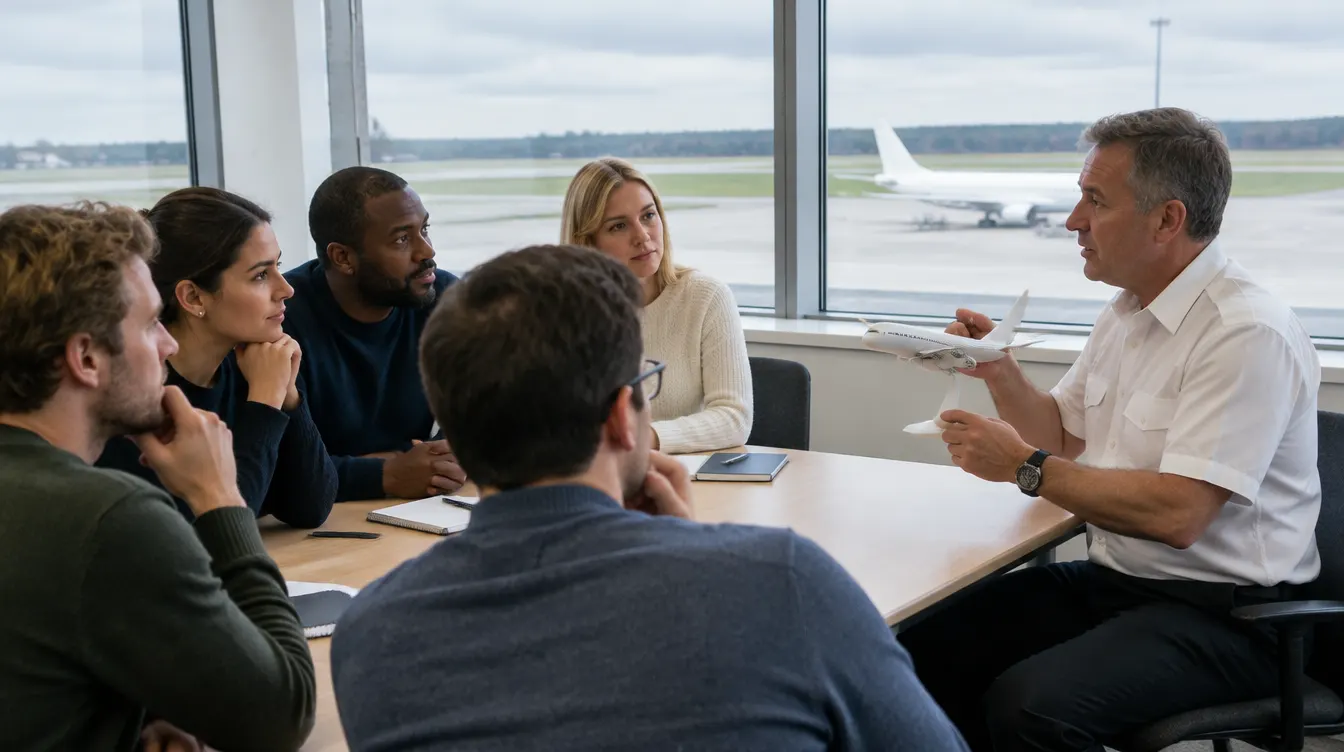
For a real phobia, the NHS lists cognitive behavioural therapy (CBT) among the treatments and suggests checking whether airlines run sessions. The good courses follow the CBT recipe: explain what's happening, teach you to handle the anxiety, then put you on a plane with support.
Lufthansa Aviation Training is a good example of the format. Its one-day intensive seminar ends with a 90-minute round flight in a chartered A320-family jet, with one psychologist for every five participants. The weekend seminar takes 6 to 12 people over two days and ends with a scheduled Lufthansa or SWISS flight to a European city and back. Both are held in German; the weekend one can be run in English on request.
Whatever you choose, avoid anything that promises a cure without ever getting you near an aircraft. Information alone rarely does it; it's the flight with someone beside you that resets the fear.
Knowing what your flight is doing
A lot of flight anxiety is really uncertainty. Is the delay a problem? Why are we still at the gate? Is that descent normal? I built Bordy partly because I hate not knowing, and it helps here in plain, practical ways.
Add your flight by number and Bordy re-checks it every two minutes from FlightAware's data. You get a push when departure moves (with the old and new time), when the gate changes, at boarding, departure and landing. If the cabin has Wi-Fi, you can watch your altitude and ground speed hold steady at cruise instead of guessing. All of that is free. Pro adds where the aircraft for your flight is right now, so if you're stuck at the gate because your plane hasn't arrived yet, you can see it on its way.
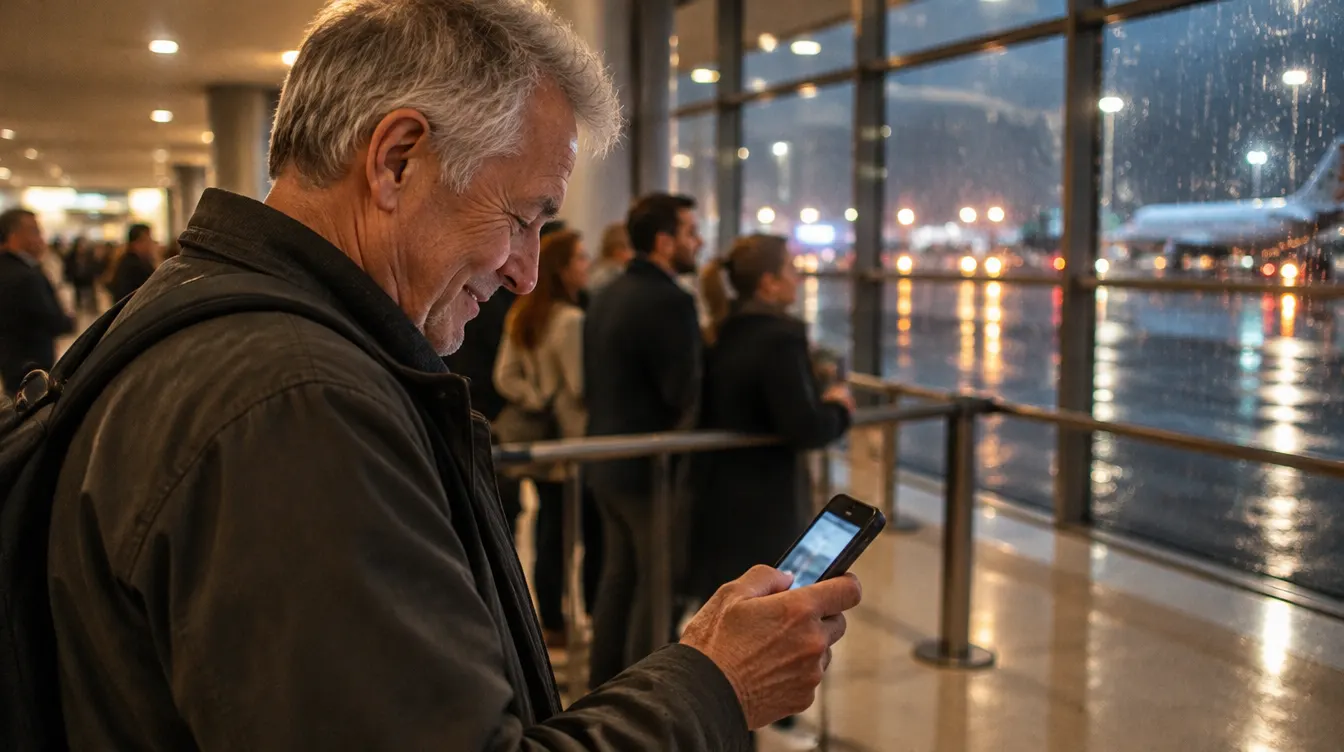
It also helps the people who worry about you. Send them your flight number: they can follow the same status and get the landing push without refreshing a website. Bordy won't predict turbulence or cure a phobia. It just takes the guesswork out of the parts that can be known.
Questions people actually ask
Is flying really the safest way to travel?
Why do the engines go quiet after take-off?
Can a plane fly with one engine?
Should I take a sedative or drink before flying?
Do fear-of-flying courses work?
Where these numbers come from
- ICAO: analysis of 2025 safety data (news release, 23 July 2026) — checked 15 November 2026
- ICAO: 2024 aviation safety data (news release, 11 August 2025) — checked 15 November 2026
- IATA: 2025 Annual Safety Report (press release, 9 March 2026) — checked 15 November 2026
- FAA Advisory Circular 91-53A, Noise Abatement Departure Profiles (PDF) — checked 15 November 2026
- FAA Airplane Flying Handbook, chapter 16: transition to jet-powered airplanes (PDF) — checked 15 November 2026
- 14 CFR § 25.121, Climb: one-engine-inoperative (Cornell LII) — checked 15 November 2026
- EASA: The how's and why's of flying — checked 15 November 2026
- NHS: breathing exercises for stress — checked 15 November 2026
- NHS: treatment for phobias — checked 15 November 2026
- Lufthansa Aviation Training: fear-of-flying intensive seminar (in German) — checked 15 November 2026
- Lufthansa Aviation Training: fear-of-flying weekend seminar (in German) — checked 15 November 2026
- Lufthansa Aviation Training: tips against fear of flying (in German) — checked 15 November 2026