Flight statistics · Updated November 2026
How often flights go wrong,
and how often people miss them
Most flights leave more or less on time. But “most” hides a lot: in the US in 2025 more than one flight in five arrived at least 15 minutes late, and in Europe almost one in four did. Here is what the official numbers say, what nobody actually measures, why your flight and gate change after you book, and which tools tell you soonest.
In brief
- USA, 2025: 76.4% of flights arrived on time (less than 15 minutes late), 21.8% were delayed, 1.5% were cancelled. Source: the Bureau of Transportation Statistics.
- Europe, 2025: 76.1% of flights arrived within 15 minutes of schedule and 70.1% departed on time, according to Eurocontrol.
- Missed flights: no airline, airport or regulator publishes how many passengers miss their flight. The figures floating around online come from surveys and compensation firms.
- The biggest single cause of US delays in 2025 was the aircraft arriving late from its previous flight: 7.96% of all flights.
- Gates are decided on the day. Heathrow usually shows yours about 45 minutes before departure; Madrid-Barajas makes no PA announcements about gate changes.
- Tracking it yourself means not depending on one SMS or one screen: the airline app for your booking, a tracker for any flight, the board as the final word.
What the official numbers say
The United States has the most detailed public data. Large US airlines must report every domestic flight to the Department of Transportation, and the Bureau of Transportation Statistics (BTS) publishes the result. A flight counts as on time if it arrives less than 15 minutes after its scheduled time.
For January–December 2025, BTS shows 76.42% of flights on time, 1.53% cancelled and 0.27% diverted. Everything else, about 21.8%, arrived late. In 2024 the DOT's Air Travel Consumer Report counted 7.5 million flights, 78.1% of them on time and 1.4% cancelled, so 2025 was a slightly worse year.
Europe measures it the same way, within 15 minutes. Eurocontrol, which manages the European air traffic network, counted 11.1 million flights in 2025. 76.1% arrived on time and 70.1% departed on time, better than 2024 but still below 2019. Summer is the weak spot: from June to August 2025 arrival punctuality was 71.1%.
| On time (within 15 min) | Cancelled | Source | |
|---|---|---|---|
| USA, 2025 | 76.4% of arrivals | 1.5% | BTS, January–December 2025 |
| USA, 2024 | 78.1% of arrivals | 1.4% | DOT Air Travel Consumer Report |
| Europe, 2025 | 76.1% of arrivals, 70.1% of departures | Not given in the annual overview | Eurocontrol |
Averages hide big differences between airlines. Among Europe's 30 largest operators in 2025, SAS reached 87% arrival punctuality and the Iberia Group 85%, while TAP was at 61%. If your airline sits at the bottom of that list, a delay is not bad luck, it is the base rate.
And how many people miss their flight?
Honest answer: nobody publishes it. Airlines know their no-show numbers, since that is what overbooking is built on, but they keep them internal. No regulator in the US, the EU or Russia releases a count of passengers who missed a flight, so any precise percentage you see online comes from a survey or a claims company.
The closest official figure is about being bumped, not missing a flight. In 2024 the DOT counted 25,469 passengers involuntarily denied boarding on US airlines, out of roughly 900 million: 0.28 per 10,000. Another 290,555 gave up their seats voluntarily for compensation.
Missed connections are also not counted publicly, but the rules show who carries the risk. EU rules can entitle you to compensation for a missed connection, but not if you missed it because of security queues or because you were late for boarding at the transfer airport. Details in our missed connection guide.

Why your flight changes after you book
- Schedule changes weeks ahead. Airlines reshuffle timetables long before the day. Under EU rules, if you are told about a cancellation at least 14 days before departure, no compensation is due, so plenty of changes land in your inbox well in advance.
- The inbound aircraft. Your plane usually flies another route first. In the US it was the largest single delay cause in 2025, hitting 7.96% of all flights. In Europe, every minute of original delay generated another 0.79 minutes of knock-on delay later in the day. More in why flights are delayed.
- Air traffic control and weather. The US “National Aviation System” category, which covers traffic volume, heavy weather and airport operations, delayed 6.32% of flights in 2025.
- One-off disruptions. Eurocontrol lists the electrical substation fire at Heathrow, a cyberattack on check-in systems at Heathrow, Brussels and Berlin, and drone sightings at several airports. These show up mostly as cancellations, not delays.
Why gates change
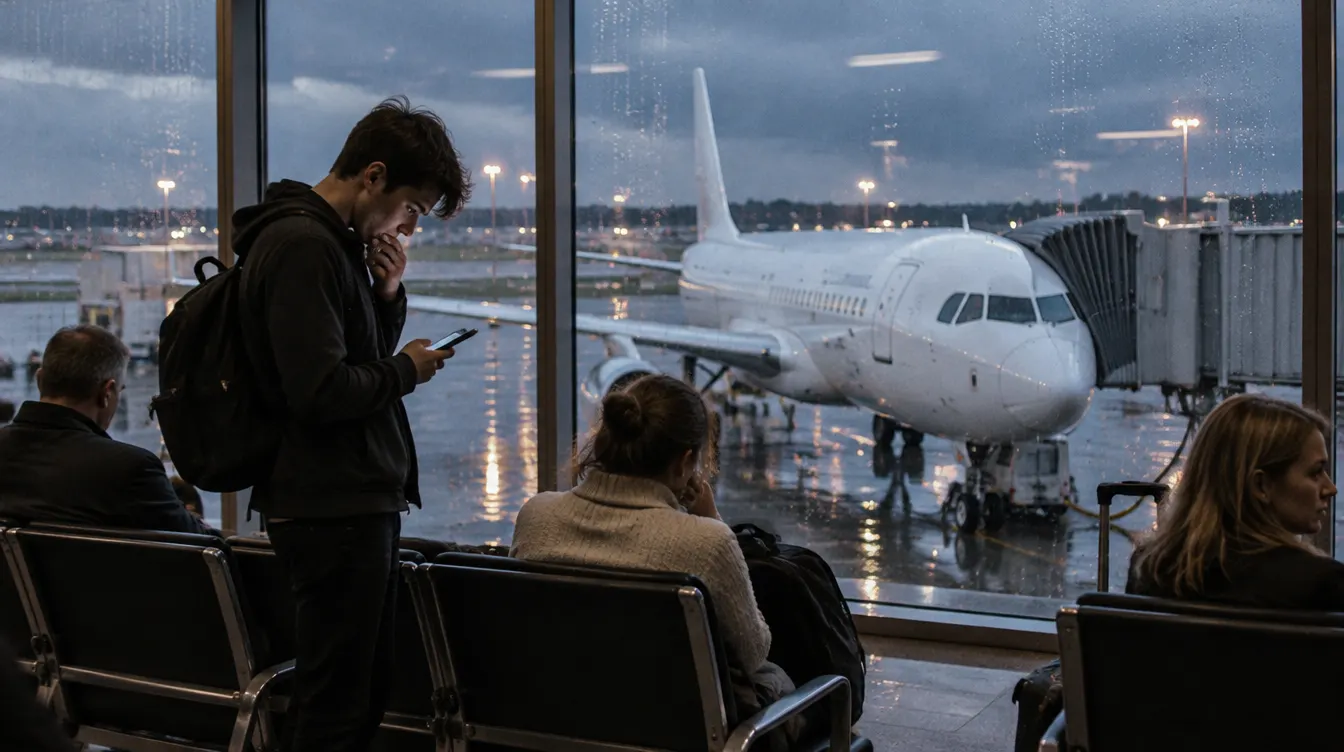
The gate is not part of your booking. The airport and airline assign it on the day, juggling free stands, late aircraft and which flights need passport control. Heathrow says your gate is usually shown on the screens around 45 minutes before departure. When an inbound plane is late, the stand it was due at may go to another aircraft, and your gate moves.
Airports also differ in how loudly they tell you. Frankfurt shows the walking time to each gate on its boards once the gate is fixed. Madrid-Barajas says plainly that it makes no PA announcements about gate assignments or changes: watch the screens. See how to find your gate.
Why it pays to track the flight yourself
- One channel is not enough. The airline's SMS or e-mail arrives when the airline updates the status. Until then, it still says “on time”.
- The board only covers today, at one airport. It is the final word on the gate, but useless at home the night before.
- Connections. On a separate ticket, the second airline doesn't know your first flight is late. You have to watch both.
- Picking someone up. You are not on the booking, so no airline will message you. A tracker that follows any flight number will.
- Peace of mind. A push when something changes beats refreshing the airport website every ten minutes.

The tools, compared honestly
| Tool | Good at | Limits |
|---|---|---|
| Airline app | Your booking, rebooking, boarding pass, status straight from the airline | Only that airline's flights; a second airline on the trip means a second app |
| Airport website and boards | The official gate and status at that airport | One airport, mostly today's flights, and you have to keep looking |
| Flightradar24 | A live map of air traffic worldwide; the basic app is free | Alerts and 90 days of history need the Silver subscription; 365 days come with Gold |
| FlightAware | Free alerts for departure, arrival, cancellation, gate change, delay and diversion, plus “Where is my plane?” | Removing ads is a paid subscription; extra features sit in FlightAware Aviator |
| Flighty | Free tracking of unlimited flights; Pro adds fast alerts, Live Activities, delay forecasts, calendar sync and a connection assistant | Most of the alerting is Pro: $59.99 a year or $4.99 a month on Flighty's site; Pro is free for your first flight |
| TripIt | Builds an itinerary from confirmation e-mails forwarded to plans@tripit.com, free | Real-time flight alerts are part of TripIt Pro, $48.99 a year on the US App Store |
A sensible setup is two layers. The airline app for anything that changes your booking, because rebooking happens there. And one tracker that covers every flight you care about, including other people's. On the day, the airport screens settle any disagreement.
One more option: Bordy
Bordy is a free iPhone flight tracker built around the flights you add, not a map of all traffic. It reads FlightAware's AeroAPI, re-checks an active flight every two minutes and sends a push for gate changes, delays (with the old and the new time), boarding, departure and landing. These alerts are free, with no cap on the number of flights, and work for any flight number, including one you are only meeting at arrivals.
Bordy Pro (€44.99 a year, three-day free trial) adds the gate, seat, terminal and boarding time on the flight's card and shows where the aircraft for your flight is right now, the early hint of a knock-on delay. What it doesn't have: Live Activities, an Apple Watch app, delay prediction or an Android version. It has no ads, can pick up flights from booking e-mails in Gmail or any IMAP mailbox.
Questions people actually ask
How many people miss their flight each year?
What percentage of flights are delayed?
What percentage of flights are cancelled?
Will the airline tell me about a gate change?
Which app tells you about a delay first?
Where these numbers come from
- BTS: Airline On-Time Statistics and Delay Causes, January–December 2025 — checked 14 November 2026
- US DOT: Air Travel Consumer Report, full year 2024 (National Transportation Library) — checked 14 November 2026
- Eurocontrol: European Aviation Overview, 2025 review (PDF) — checked 14 November 2026
- Eurocontrol: Performance Review Report 2025 (PDF) — checked 14 November 2026
- Your Europe: air passenger rights — checked 14 November 2026
- Heathrow: departure lounge and boarding — checked 14 November 2026
- Aena, Madrid-Barajas: departures area (in Spanish) — checked 14 November 2026
- Frankfurt Airport: transferring at FRA (in German) — checked 14 November 2026
- Flighty: pricing — checked 14 November 2026
- FlightAware Flight Tracker on the App Store — checked 14 November 2026
- Flightradar24 on the App Store — checked 14 November 2026
- TripIt on the App Store — checked 14 November 2026